Introduction
For the Center for Coastal Studies in Provincetown, Massachusetts, a dependable inflatable boat or rigid inflatable boat is more than a recreational vessel. Its working fleet supports marine research, environmental monitoring, conservation programs, and authorized responses to entangled whales and other marine animals. When a boat contributes to work of this importance, reliability is an operational requirement.
East Coast Inflatables is responsible for specialized inflatable boat and RIB fleet maintenance for this internationally recognized organization. This work helps the Center keep its vessels prepared for the demanding conditions encountered in Cape Cod Bay and surrounding New England waters. Careful inspections, preventative maintenance, leak detection, valve service, tube care, and appropriate repairs all contribute to that readiness.
The relationship reflects the confidence that professional marine operators place in East Coast Inflatables. It also demonstrates why specialized maintenance matters to every inflatable boat owner. Whether a RIB supports scientific fieldwork, public safety operations, commercial activity, fishing, tender service, or family recreation, its reliability begins with knowledgeable care and an honest assessment of its condition.
A Marine Mission Supported by Working Boats
Founded in 1976, the Center for Coastal Studies is a nonprofit organization dedicated to understanding, preserving, and protecting marine ecosystems and coastal environments. Based in Provincetown, the Center conducts independent, field-based research in Cape Cod Bay, the Gulf of Maine, and other parts of the western North Atlantic.
The Center’s work encompasses North Atlantic right whales, humpback whales, marine animal entanglement response, fisheries, seals, sharks, water quality, marine debris, coastal geology, habitat conditions, and public education. Scientists conduct research cruises, collect samples, document individual animals, monitor changes in the marine environment, and provide scientific information to resource managers.
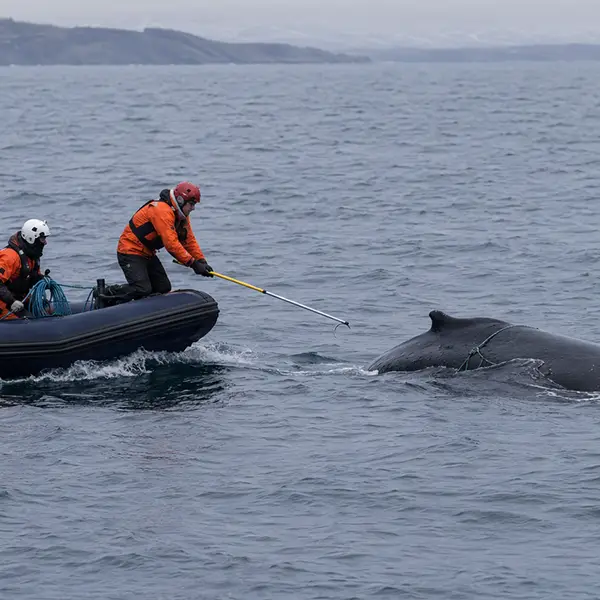
Boats are essential tools in many of these programs. Depending on the assignment, a working vessel may carry researchers, animal-response specialists, scientific instruments, cameras, sampling equipment, tracking equipment, or other field resources. Crews may work close to shore, cross open areas of Cape Cod Bay, or operate around a moving marine animal while maintaining a safe distance.
These are very different activities, and not every vessel performs every role. However, they share a common need for dependable equipment. Researchers and responders must be able to focus on the work in front of them without an avoidable inflatable-system problem interfering with the mission.
That is why professional inflatable boat maintenance is important for a working fleet. Reliable air retention, sound tubes, properly functioning valves, and early identification of developing concerns help keep inflatable boats and RIBs prepared for regular use.
Right Whale Monitoring, Protection, and Rescue
The Center for Coastal Studies is especially well known for its work involving the critically endangered North Atlantic right whale. For decades, its researchers have studied how right whales use Cape Cod Bay, where they travel, what they feed on, and how environmental conditions influence their behavior and distribution.
Weather permitting, research crews conduct field cruises during the winter and spring. Scientists collect information about temperature, salinity, water depth, light, and plankton abundance. These measurements help them understand the habitat conditions that attract feeding right whales to Cape Cod Bay.
Aerial surveillance provides a broader view of the whale population. Researchers fly organized routes over the Bay to find right whales, document their locations and behavior, photograph identifying features, and look for injuries or evidence of entanglement. Individual right whales can be recognized by naturally occurring callosity patterns on their heads as well as scars and other physical characteristics.
The Center rapidly shares important observations with government agencies and marine-resource managers. That information can contribute to mariner advisories and time-sensitive management decisions intended to reduce vessel-strike and entanglement risks. In this way, field research becomes a practical part of right whale protection.
The Center’s Marine Animal Entanglement Response program performs a related but distinct role. Its federally authorized and specially trained responders assess whales and other marine animals that have become caught in fishing gear. When the animal, weather, available resources, and complexity of the entanglement allow, the team may undertake a controlled disentanglement operation.
This is highly specialized and potentially dangerous work. Members of the public should never approach or attempt to free an entangled whale. Reports should be made immediately to the Center’s entanglement hotline at 800-900-3622 or to the U.S. Coast Guard on VHF Channel 16. Mariners should maintain a safe and legal distance, avoid trailing lines, and follow instructions from authorized responders.
Research, protective monitoring, and emergency response all depend on trained people. They also depend on working equipment. A reliable boat cannot guarantee the outcome of a mission, but it gives the professionals aboard an appropriate platform from which to carry out their responsibilities.
Why Specialized Inflatable Boat Fleet Maintenance Matters
Inflatable boats and RIBs offer qualities that make them valuable for many professional operations. Their buoyant tubes, stability, maneuverability, and practical deck arrangements can support observation, research, patrol, and response activities. Those advantages depend on the condition of the inflatable systems.
A slow leak, inconsistent valve, damaged seam, worn area, or unnoticed abrasion may begin as a minor concern. If it progresses, it can affect air retention, tube shape, handling, reliability, and the availability of the boat when it is needed. For a working fleet, an unexpected problem can interrupt carefully scheduled fieldwork or require personnel to change operational plans.
East Coast Inflatables specializes specifically in inflatable boats and rigid inflatable boats. Its expertise is concentrated on the systems and construction that distinguish these vessels from conventional boats. That specialization supports more accurate inspection, appropriate repair decisions, and practical maintenance recommendations.
Professional RIB and inflatable boat repairs can address punctures, seam concerns, valve problems, air loss, abrasion, previous repair failures, and other forms of tube damage. The appropriate response depends on inspection, the boat’s condition, the affected area, the extent of deterioration, and the economics of the work.
Not every boat needs the same repair, and not every damaged or aging tube should automatically be restored. A small, isolated problem may be a practical repair candidate. Widespread deterioration or repeated failures may require a broader evaluation. An honest recommendation recognizes the difference.
This condition-based approach is especially important for fleet operators. Maintenance decisions must consider how the boat is used, the consequences of unexpected downtime, the reliability expected from it, and whether a proposed repair offers reasonable long-term value.
Preventative Care and Operational Readiness
Waiting for an obvious failure is rarely the best way to manage a working inflatable boat. Preventative care helps reveal developing concerns while there is still time to evaluate and address them in an orderly manner.
A thorough inflatable-boat inspection may identify slow pressure loss, valve leakage, seam changes, abrasion, surface deterioration, contamination, or an aging previous repair. Finding these conditions early can reduce the chance that a manageable problem will become more extensive during an active operating period.
Proper inflation is another part of reliable ownership. Tube pressure changes as air and water temperatures rise and fall. New England boats can experience cool mornings, direct summer sunlight, changing winds, and cold seawater within a single operating day. Owners and fleet personnel should understand these changes and follow the boat manufacturer’s inflation guidance.
Cleaning and surface care also affect tube longevity. Salt, sand, dirt, marine growth, spilled substances, unsuitable cleaning products, and prolonged ultraviolet exposure can gradually affect inflatable surfaces. Appropriate cleaning practices and UV protection help preserve tube condition and make it easier to recognize physical changes during an inspection.
East Coast Inflatables provides seasonal maintenance focused on the inflatable portion of the boat. This may include tube-condition evaluation, leak checks, valve inspection, seam inspection, pressure-related checks, and identification of developing repair needs. These services do not include engine service, mechanical maintenance, winterization, storage, or boat wrapping.
For an organization such as the Center for Coastal Studies, preventative attention supports fleet planning and operational readiness. For a recreational owner, the same approach can help prevent an avoidable problem from disrupting a family trip, fishing day, or tender operation.
Professional Trust Earned Through Reliability
The Center for Coastal Studies has earned international recognition through decades of marine research, conservation, education, and animal-response work. Its scientists and responders collaborate with government agencies, research institutions, fishermen, conservation organizations, and other specialists. The organization’s findings contribute to a wider understanding of marine ecosystems and the threats facing protected species.
An organization with those responsibilities must be thoughtful about the people it trusts to help maintain its working boats. East Coast Inflatables’ responsibility for the Center’s inflatable boat and RIB fleet maintenance reflects confidence in specialized knowledge, careful workmanship, practical communication, and dependable support.
That trust is not based on exaggerated promises. It is earned by inspecting boats carefully, identifying the source of a problem, recommending appropriate work, and communicating honestly about repair expectations. A boat that appears soft, for example, does not automatically have an obvious puncture. Pressure loss may involve a valve, seam, previous repair, localized damage, temperature change, or another condition that requires methodical evaluation.
Professional fleet work also demands consistency. Inspecting one boat carefully is important, but maintaining a fleet requires an organized understanding of recurring use, seasonal demands, developing concerns, and the practical effect of removing a vessel from service. Maintenance must support reliability without assuming that every imperfection requires the most extensive possible repair.
The Center’s trust is meaningful because its boats contribute to work with real environmental and conservation value. It also reflects the broader standard East Coast Inflatables applies when helping any owner protect an inflatable boat or RIB.
The Same Specialized Care for Every RIB Owner
Most inflatable boat owners will never use their vessels for whale monitoring, scientific sampling, or marine animal response. They may use a RIB for fishing, family recreation, commercial work, municipal operations, or as a tender for a larger yacht. Even so, they depend on many of the same fundamentals: reliable inflation, sound tubes, predictable performance, and confidence that developing problems have not been ignored.
The operating environment may be different, but the causes of tube deterioration are often familiar. Abrasion can worsen through repeated use. Sun exposure can contribute to surface aging. Salt and contamination can remain on tubes when cleaning is deferred. Improvised repairs may fail because the materials, preparation, or techniques were inappropriate. A small air leak can become a recurring ownership problem when its actual source is never identified.
Professional leak detection and valve repairs can help owners move beyond guesswork. A careful inspection considers valves, seams, tube surfaces, previous repairs, individual chambers, and normal pressure changes before recommending a solution.
East Coast Inflatables also recognizes that maintenance decisions affect more than the immediate repair bill. Proper care can support safety, seasonal readiness, tube longevity, ease of ownership, and long-term boat value. Conversely, repeatedly postponing a developing problem may increase damage or leave a boat unavailable at an inconvenient time.
Maintaining the Center for Coastal Studies fleet is a significant responsibility because those boats help support an important mission. The relationship illustrates a principle that applies to every inflatable boat owner: reliability begins with specialized knowledge, preventative attention, realistic recommendations, and work performed with an understanding of inflatable boat construction.
Frequently Asked Questions
Q: What fleet maintenance does East Coast Inflatables provide for the Center for Coastal Studies?
A: East Coast Inflatables is responsible for specialized maintenance of the Center’s inflatable boats and RIBs. The work focuses on inflatable tubes and related systems, including inspections, air retention, valves, seams, tube care, preventative maintenance, and appropriate repairs. It does not imply responsibility for engines, mechanical systems, storage, or winterization.
Q: Are all Center for Coastal Studies boats used for right whale rescue?
A: No. The Center conducts many forms of marine research, monitoring, conservation, and education. Different boats may support different programs, and owners should not assume that every vessel participates in Marine Animal Entanglement Response operations.
Q: Does East Coast Inflatables provide the same type of specialized care to recreational RIB owners?
A: Yes. East Coast Inflatables serves recreational, commercial, municipal, and public safety customers. Each recommendation depends on the boat’s use, age, tube condition, damage, repair history, and overall repair economics.
Slow air loss isn’t always easy to diagnose. East Coast Inflatables specializes in locating leaks and identifying valve, seam, and tube issues. Contact us to schedule a professional inspection.
IMAGE PROMPT: Photorealistic professional commercial photography, square 1:1 aspect ratio, high-resolution: marine researchers aboard a well-maintained rigid inflatable boat conducting wildlife monitoring on calm coastal New England waters, professional and authentic, no logos, no watermarks, no readable text.
META DESCRIPTION: Learn why the Center for Coastal Studies trusts East Coast Inflatables to maintain its working inflatable boat and RIB fleet.