Introduction
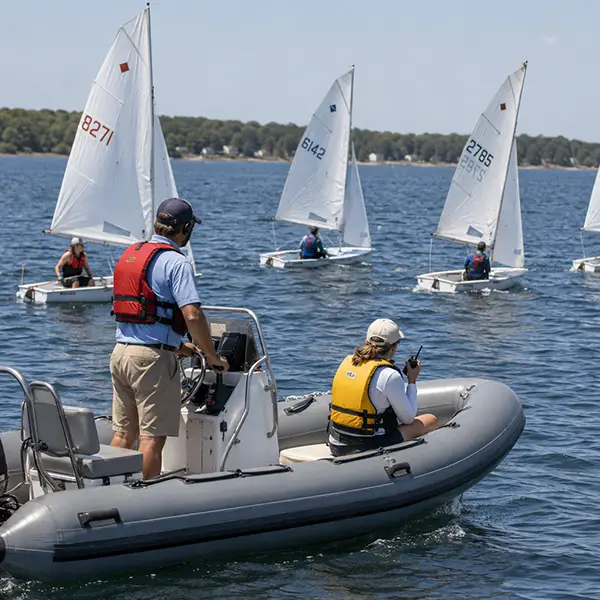
Sailing schools need support boats that can perform several jobs well. Instructors may use them to supervise students, set course marks, carry equipment, provide assistance, and respond when a sailor needs help. In the changing wind, current, chop, and harbor traffic around New Bedford, the right support boat can directly affect the quality and safety of an instructional program.
Inflatable boats and rigid inflatable boats are particularly well suited to this work. Their buoyant tubes, stability, maneuverability, and relatively forgiving sides allow instructors to operate close to small sailboats while maintaining a practical working platform. A properly selected RIB can support beginner classes, youth programs, racing instruction, adult lessons, and other on-the-water activities.
This guide explains why inflatable boats are an ideal choice for New Bedford sailing schools, which characteristics matter most, and how preventative maintenance contributes to reliable operation. It also outlines the questions a school should consider when choosing, inspecting, or maintaining a support-boat fleet.
Support Boats for New Bedford Sailing Programs
A sailing-school support boat must adapt to the needs of instructors and students throughout the day. One class may involve young beginners learning to steer and trim a sail. Another may focus on racing tactics, advanced boat handling, or practice in stronger wind. Instructors need a boat that can move efficiently between groups without becoming difficult to control at lower speeds.
Support boats may be used to:
- Observe students from an appropriate distance
- Carry instructors, safety personnel, and teaching equipment
- Set, retrieve, and reposition course marks
- Provide assistance when a student capsizes or encounters difficulty
- Escort a group between its launching area and training location
- Respond to changing weather, current, and harbor conditions
- Support regattas, practice sessions, and organized events
New Bedford presents a genuine coastal operating environment. Sailing programs may contend with commercial vessel traffic, wakes, tidal movement, changing visibility, and wind that varies across the harbor. A support boat must remain practical in calm conditions while offering the stability and reserve buoyancy needed when the water becomes less predictable.
Inflatable boats and RIBs meet these requirements particularly well. Their design gives instructors a usable combination of stability, capacity, and responsive handling. Schools evaluating their options can begin with a structured guide to buying a RIB, then refine the decision around enrollment, instructor needs, training areas, and the type of sailing program being supported.
Stability and Close-Range Student Support
Stability is one of the most important reasons sailing schools choose inflatable boats. Large buoyant tubes help create a secure platform for instructors who need to observe students, handle equipment, or move within the boat. This is useful when an instructor is demonstrating a technique, retrieving a course mark, or preparing to assist a sailor.
The tubes also provide substantial reserve buoyancy around the perimeter. When occupants shift their weight or equipment is moved, a properly loaded inflatable boat generally offers reassuring stability. That does not eliminate the need to follow capacity limits and distribute weight correctly, but it creates a practical platform for active instructional work.
Inflatable tubes can be more forgiving than hard-sided boats during controlled close-range operations. Sailing instructors sometimes need to approach a small dinghy to communicate with a student, provide assistance, or stabilize the situation. A soft inflatable surface reduces the likelihood of the support boat’s side causing the type of contact damage associated with an exposed rigid gunwale.
That advantage must never be treated as permission for careless handling. Instructors should approach students at an appropriate speed and angle while accounting for wind, current, propeller position, and the movement of both boats. The operator remains responsible for maintaining control and protecting people in the water.
A support boat should also have enough usable space for its intended crew and equipment. Overloading reduces stability and freeboard while making it harder for instructors to move safely. Capacity decisions should consider people, safety gear, anchors, marks, lines, and any equipment carried during a normal teaching session—not just the number of available seats.
Maneuverability for Instructors and Coaches
Sailing instruction often requires frequent changes in position. A coach may observe one student, move to another part of the course, check a mark, and then return to the group. The support boat must respond predictably without creating excessive disruption for nearby sailors.
Inflatable boats and RIBs are valued for responsive handling and the ability to operate effectively in confined areas. Appropriate hull design, properly maintained tubes, balanced loading, and an operator familiar with the boat all contribute to controlled maneuverability.
Low-speed control is especially important. Sailing classes spend much of their time in relatively compact training areas where students may change direction unexpectedly. Instructors need to anticipate those movements and maintain enough space to avoid crowding a beginner. The support boat should be positioned where the instructor can observe and communicate without becoming an obstacle.
RIBs can also move promptly when assistance is needed farther away. If a student drifts from the group, has difficulty recovering from a capsize, or encounters an unexpected problem, the instructor can reach the area efficiently. The goal is not speed for its own sake, but the ability to respond in a controlled and timely manner.
Predictable handling depends partly on tube pressure. An underinflated tube may alter the boat’s shape, increase movement, and affect how the vessel performs. Excessive pressure can place unnecessary stress on tubes and related components. Sailing schools should follow manufacturer guidance and account for pressure changes caused by temperature and direct sunlight.
Choosing an Inflatable Boat for a Sailing School
There is no single inflatable boat configuration that is correct for every sailing school. A small seasonal youth program has different requirements from a large organization running multiple classes, regattas, and advanced coaching sessions. The selection process should begin with how the boat will actually be used.
Important questions include:
- How many instructors and safety personnel will normally be aboard?
- What equipment, marks, anchors, and lines must the boat carry?
- Will it primarily support youth dinghies, adult instruction, racing, or mixed programs?
- How far will it travel from the launching area?
- What wind, current, wake, and wave conditions are typical?
- How frequently will the boat be used during the season?
- How will the school transport, launch, and recover it?
- Who will be responsible for daily inspections and pressure checks?
Size should reflect the realistic operating load. A boat that is too small may become crowded once instructors, required safety equipment, and course gear are aboard. A boat that is unnecessarily large may be harder to manage around a compact teaching area and may create transportation or launching complications.
The layout should allow instructors to move safely while keeping loose lines and equipment organized. Storage for safety gear is valuable, but it should remain accessible. Frequently handled equipment should be positioned where it can be reached without forcing an instructor to step over passengers or create a trip hazard.
Visibility also deserves attention. The operator should have a clear view of the surrounding water, including students close to the boat. Seating and equipment should not create avoidable blind spots. If several people operate the boat, controls and procedures should be consistent enough that each authorized instructor understands its handling characteristics.
A consultation with an inflatable boat specialist can help a school compare capacity, size, layout, intended use, and long-term ownership requirements before making a purchasing decision. This is more useful than selecting a boat solely from a capacity plate or overall length.
Maintenance for a Hard-Working School Fleet
Sailing-school boats can accumulate considerable use within a relatively short season. Repeated launching, equipment handling, contact with docks, exposure to sun and saltwater, and frequent changes of operator all contribute to wear. A structured maintenance process helps schools identify problems before they disrupt instruction.
Daily or pre-use checks should focus on readily observable conditions. Staff should look for unexpected pressure loss, visible abrasion, cuts, damaged fittings, questionable seams, and changes around valves or previous repairs. Loose equipment and lines should be secured, and the boat should not be used beyond its rated capacity.
When a boat appears softer than expected, the cause should be investigated rather than repeatedly adding air without explanation. Temperature changes may account for some pressure variation, but recurring air loss may indicate a valve, seam, puncture, chamber, or previous repair problem. Professional evaluation can help distinguish ordinary pressure changes from a developing leak.
Cleaning practices also matter. Salt and dirt should not be allowed to accumulate indefinitely on inflatable surfaces. Harsh chemicals, aggressive scrubbing, and unsuitable protectants may cause damage rather than prevent it. Schools should use products and techniques appropriate for inflatable boat tubes.
UV exposure is another long-term consideration for boats that remain outside throughout a busy instructional season. Appropriate UV protection and tube care can help reduce avoidable surface deterioration. Protection should be combined with routine cleaning and inspection rather than treated as a substitute for them.
East Coast Inflatables provides specialized repair and maintenance for inflatable boats and RIBs. Recommendations depend on inspection, boat condition, damage, repair history, and whether the proposed work offers practical value.
Building Long-Term Fleet Reliability
Reliable fleet management begins with consistency. Sailing schools should establish clear responsibilities for pre-use checks, cleaning, pressure monitoring, and reporting damage. When everyone assumes someone else has inspected a boat, small concerns can be overlooked.
A simple written record can help staff track recurring air loss, previous repairs, inspection findings, and unusual events. If a boat contacts a dock, handles a difficult recovery, or experiences an unexpected pressure change, documenting the event gives the next operator and repair specialist useful context.
Damage should be evaluated promptly. Temporary or improvised patches may conceal the original condition, complicate a later professional repair, or fail during use. A sailing school should avoid applying unverified products to a tube without understanding whether they are appropriate for the boat and the affected area.
Seasonal inspections offer an opportunity to assess the fleet beyond daily checks. Valves, seams, tube surfaces, pressure retention, and previous repairs can be examined for developing problems. East Coast Inflatables offers seasonal maintenance focused on inflatable boats and RIBs. This service does not include engine maintenance, mechanical repairs, winterization, storage, or boat wrapping.
Not every older school boat automatically needs extensive repairs or tube replacement. The right decision depends on overall condition, the number and location of problems, the boat’s role, and the economics of continued service. Some boats remain practical repair candidates, while others may no longer provide the reliability a school requires.
Inflatable boats are an excellent match for sailing schools because they combine stability, maneuverability, useful capacity, and relatively forgiving sides. Those advantages are best preserved through proper selection, responsible operation, regular inspection, and specialized maintenance. For sailing programs in New Bedford, that combination can support safer instruction and more dependable time on the water.
Frequently Asked Questions
Q: What size inflatable boat does a sailing school need?
A: The appropriate size depends on the number of instructors, the equipment carried, the types of sailboats being supported, local conditions, and the school’s operating area. Capacity should be evaluated using the complete working load rather than passenger count alone.
Q: How often should a sailing-school RIB be inspected?
A: Staff should perform basic condition and pressure checks before use. More detailed inspections should be scheduled periodically and whenever the boat develops recurring air loss, visible damage, valve concerns, seam changes, or a failed previous repair.
Q: Can East Coast Inflatables maintain a sailing school’s inflatable boat fleet?
A: East Coast Inflatables provides specialized inflatable boat and RIB inspection, maintenance, tube care, leak detection, valve service, and appropriate repairs. Recommendations are based on the condition, use, and repair economics of each boat.
Routine inspections and preventative maintenance can help extend the life of your inflatable boat. Contact East Coast Inflatables to learn about seasonal maintenance services and tube care.