Introduction
Municipal marine departments, harbormasters, and public-safety fleets in Rhode Island routinely rely on rigid inflatable boats (RIBs) for patrols, search and rescue, environmental response, and general harbor work. Tubes are the single most critical wear item on a RIB: deteriorated tubes reduce buoyancy, increase maintenance time, and create safety risk for crews and the public.
This article provides a practical inspection checklist and a cost-benefit framework to help fleet managers decide whether to repair, retube (RIB retubing), or replace tubes. It also covers procurement and pickup/delivery logistics specific to municipal constraints so you can budget responsibly and keep boats in service.
Read on for step-by-step evaluation guidance, red flags that push a decision toward retubing or replacement, and actionable tips on managing quotes, scheduling work, and minimizing downtime for public-safety and municipal RIBs used in Narragansett Bay and surrounding coastal waters.
Why RIB retubing matters for municipal marine departments
RIB tubes wear from UV exposure, abrasion against pilings and ramps, chemical exposure, prolonged saltwater immersion, and repeated inflation cycles. For municipal fleets that operate year-round in Rhode Island’s coastal environment, tube condition directly affects operational readiness, crew safety, and budget predictability.
Appropriate RIB retubing can restore air retention, recover freeboard and load capacity, and significantly extend the service life of a fiberglass or aluminum hull. Conversely, repeated patchwork on tubes near the end of their useful life can create a maintenance trap: frequent returns to service loss, recurring costs, and elevated risk during critical missions.
When evaluating an older RIB, combine physical inspection with an honest cost-benefit comparison between patch repairs, retubing, and full boat replacement to make defensible decisions that protect public safety and municipal budgets.
Inspection checklist: assessing tube condition and repairability
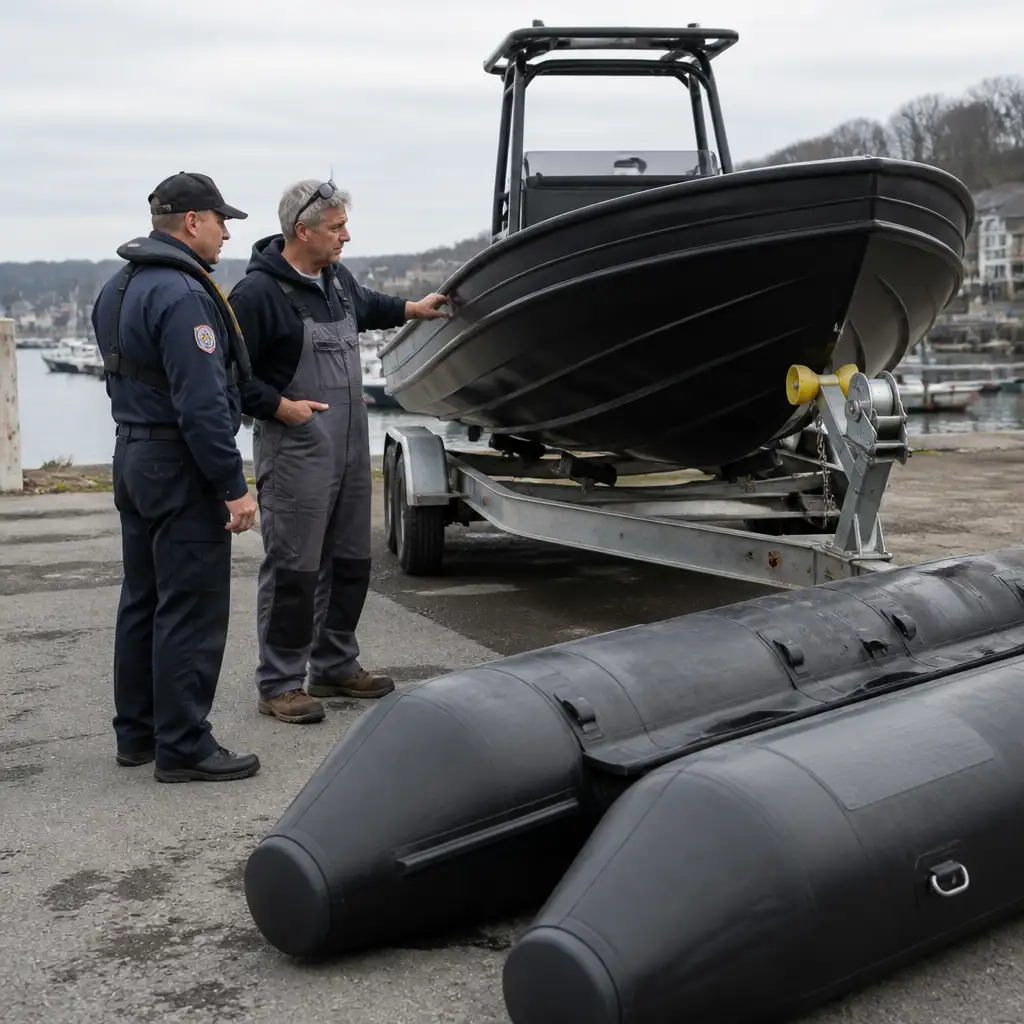
Start every assessment with a documented inspection. Use the following checklist to determine whether tubes are repairable, need retubing, or indicate structural issues beyond tube work.
- Material identification: Confirm whether tubes are Hypalon (CR) or PVC. Repair methods and long-term expectations differ. If you need material-specific guidance, consult a specialist in Hypalon repairs or PVC repairs.
- Age and exposure: Note manufacture or service dates if available. Tubes exposed to heavy sun without UV protection often show chalking, cracking, or loss of surface integrity.
- Visual surface condition: Look for surface crazing, soft spots, permanent discoloration, seam bubbling, and widespread abrasion. Is damage localized or continuous along multiple chambers?
- Seam integrity: Inspect glued or taped seams for separation, bubbling, or prior patch failures—seam failure is costly and often argues for retubing.
- Punctures and patches: Count and map patches. A single repair or two is normal; dozens of patches indicates the tube has passed its economical life.
- Valve condition: Test each valve with a pressure gauge and submersion or soap solution if needed. Valve failures are repairable but recurring valve problems with degraded surrounding material suggest retubing.
- Chamber pressure behavior: Inflate to recommended pressure and record loss over 24 hours. Slow leaks from multiple chambers typically point to broader material failure.
- Underlying hull interface: Check transom fittings, rubbing strakes, and attachment points. Excessive wear where the tube bonds to the hull can complicate retubing and require transom or shelf work.
- Photograph and document: Municipal procurement benefits from a clear record. Photos and a concise condition report simplify council or department decisions and bid specifications.
Estimating retubing costs vs repeated repairs: an economics framework
Deciding between ongoing repairs, retubing, or buying a new RIB should be a financial as well as operational decision. Use a three-year lifecycle model to compare options.
- Quantify current annual repair costs: Add parts, labor, and downtime costs for the past 12–36 months. Include indirect costs such as overtime, rental boats, or mission delays.
- Estimate retubing cost: Obtain an itemized quote for RIB retubing that includes new tubes by material (Hypalon vs PVC), labor, pressure testing, seam reinforcement, and any transom or hardware adjustments. For municipal fleets, allow for procurement lead time and contingency.
- Compare to replacement cost: For aging platforms, compare retubing plus projected maintenance for 3–5 years against the cost of a new RIB (including hull, new tubes, and outfitting). Factor in resale or disposal value of the current boat.
- Consider operational value: A retubed hull maintains hull characteristics you may already know, whereas a new RIB may offer updated layouts, higher capacity, or manufacturer warranties. Balance the nonfinancial benefits against capital expense.
- Use break-even analysis: Calculate years-to-break-even where retubing plus expected repairs becomes cheaper than continuing with repeated patches. If break-even is within a planning horizon and service life after retubing is acceptable, retubing is justified.
Fleet managers should request detailed retubing proposals from qualified inflatable specialists and compare comparable scopes. East Coast Inflatables provides tube replacement and retubing assessments and can advise on realistic life expectations after retubing; see tube replacement & retubing for typical considerations and service descriptions.
When to retube versus replace the RIB hull: decision factors
Retubing is attractive when the hull is structurally sound and the boat’s layout still meets mission needs. Replace the hull when the fiberglass or hull structure is compromised, or when operational needs have changed.
Key decision factors:
- Hull condition: Cracked or severely corroded hulls, irreparable transom damage, or major structural repairs typically point to replacement.
- Outdated configuration: If the hull cannot be retrofitted with required equipment (larger outboards are an engine question—avoid implying engine service), replacement may be necessary.
- Cost parity: If retubing plus anticipated repairs approaches the price of a suitable used or new RIB, replacement provides longer-term certainty.
- Service interruption tolerance: Retubing may be faster and less disruptive than sourcing and commissioning a new boat, an important consideration for emergency-response fleets.
Procurement, budgeting, and public-safety considerations for municipalities
Municipal budgets and procurement rules add layers to RIB maintenance decisions. Follow a transparent process: document inspections, obtain multiple quotes, and present lifecycle cost comparisons to justify spending.
Public-safety units should prioritise reliability and predictable availability. When evaluating quotes, ask vendors for:
- Material specifications (Hypalon vs PVC) and expected service life under Rhode Island coastal conditions.
- Detailed scopes: what is included in the retubing—new valves, seam reinforcement, pressure testing, and warranty terms.
- Timeline estimates tied to operational windows (season starts, patrol schedules).
For municipalities, consider setting aside contingency funds for emergent tube failures. Preventative periodic inspections and seasonal checks reduce emergency procurement and support consistent in-service rates. For maintenance planning guidance see the seasonal maintenance resource.
Pickup, delivery, and logistics for municipal RIB maintenance
Logistics matter for municipal fleets with limited transport capability. Many repair shops, including specialized inflatable technicians, offer pickup and delivery options depending on location, boat size, and scheduling. That service can reduce the manpower and vehicle time a town must provide.
When planning an out-of-service period, coordinate these steps:
- Confirm pickup availability: Ask prospective vendors whether pickup and delivery are offered, constraints, and any additional costs. See the company’s pickup and delivery information at pickup & delivery.
- Schedule around operational needs: Avoid simultaneous downtime for multiple critical boats. Stagger retubing projects to maintain coverage.
- Prepare the boat: Remove loose gear, secure electronics, and drain fuel per your internal policies (do not ask repair vendors to perform engine or fuel work).
- Document handover: Use photo logs and condition reports at pickup and delivery to avoid disputes and to support procurement records.
Well-managed pickup and delivery reduce municipal labor costs and help specialized shops concentrate on the repair work that extends tube life and returns boats to service safely and quickly.
Frequently Asked Questions
Q: How long should I expect new Hypalon tubes to last in Rhode Island saltwater use?
A: With proper UV protection, regular cleaning, and seasonal inspections, Hypalon tubes commonly last 8–15 years in coastal New England conditions. Actual life depends on exposure, storage, and use patterns.
Q: Can an older RIB be reliably retubed to meet public-safety standards?
A: Yes—when the hull structure, transom, and fittings are sound. A thorough inspection must confirm attachment points and overall hull integrity. Retubing restores buoyancy and air retention but does not address unrelated hull structural issues.
Q: What documentation should we require from a retubing vendor for municipal procurement?
A: Request a detailed written estimate, material specs (Hypalon vs PVC), warranty details, timeline, included testing (pressure and leak checks), and pickup/delivery terms. Photographic condition reports at handover are also valuable for records.
For municipalities seeking expert evaluation, inspection, or retubing quotes, East Coast Inflatables provides specialized RIB and inflatable boat services and can help you weigh repair-versus-replacement decisions based on condition and budget priorities. For general RIB repair information and to understand repair scopes, see our RIB and inflatable boat repairs page and our repair and maintenance guidance.
If your inflatable boat’s tubes are showing their age, East Coast Inflatables can help you determine whether repair or tube replacement makes the most sense. Contact us to discuss your boat and arrange an inspection.